

Press Release - 26 February 2026
New GEM 2025/2026 Global Report Finds Record Startup Activity — But Warns of Growing AI and Survival Gaps
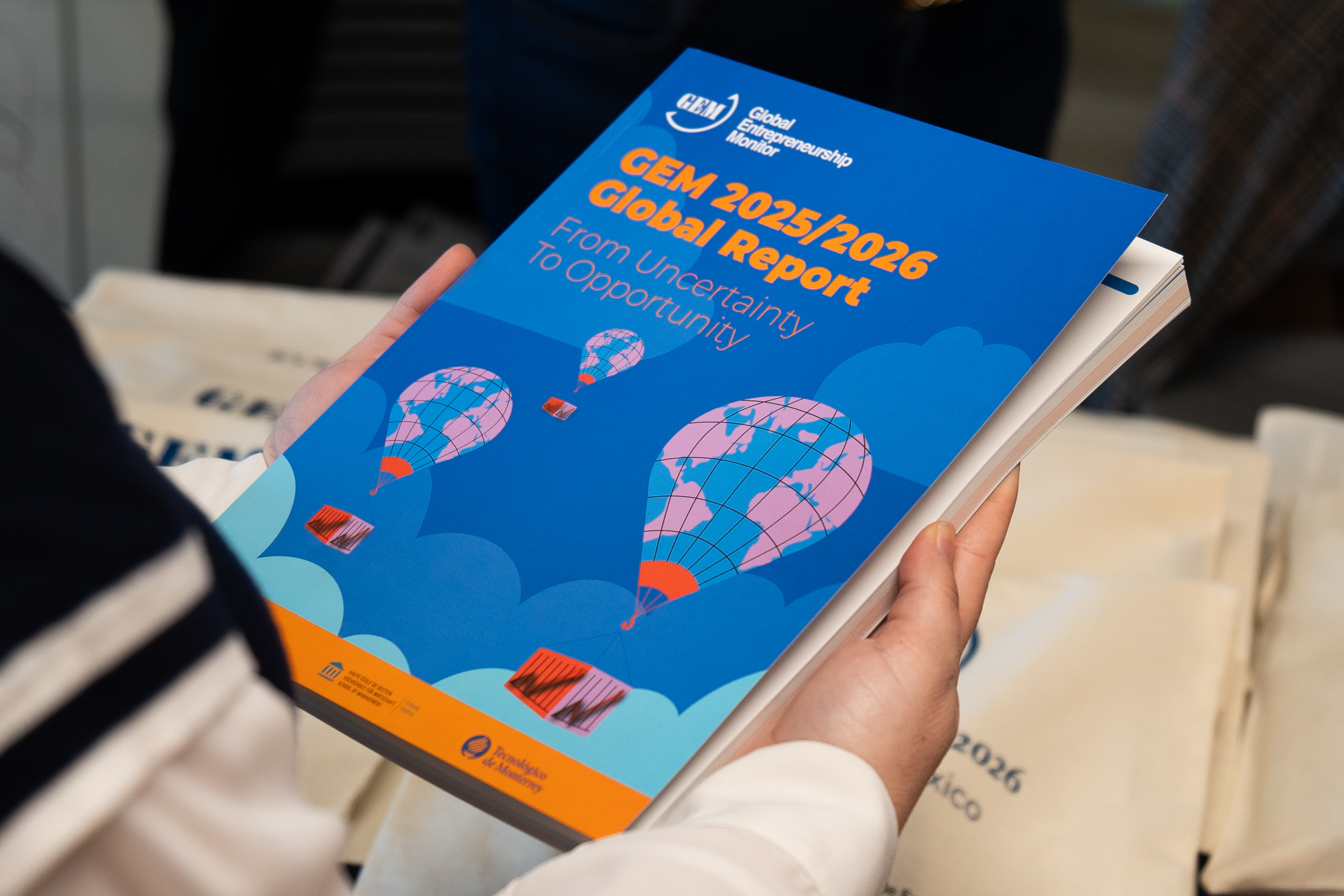
The newly released GEM 2025/2026 Global Report, launched today at Tecnológico de Monterrey in collaboration with GEM Mexico and the Instituto de Emprendimiento Eugenio Garza Lagüera, finds that entrepreneurial activity remains strong across the globe — but structural weaknesses threaten long-term sustainability.
Drawing on data from 53 participating economies, representing approximately 43% of the global population and 57% of global GDP (World Bank, 2025), the report shows that startup rates are at record levels in many regions.
However, the findings highlight two growing divides: a widening “Survival Gap”, where too few startups transition into established firms, and an expanding “AI Readiness Gap”, separating entrepreneurs with access to artificial intelligence from those without.
THE SURVIVAL GAP: HIGH STARTUP ACTIVITY, LIMITED TRANSITION TO ESTABLISHED FIRMS
While early-stage entrepreneurial activity remains robust, the report identifies a persistent structural challenge: many new ventures do not survive long enough to become established firms.
According to the report’s authors, the transition from startup to established business is constrained by structural conditions, particularly entrepreneurial education and access to finance. Without improvements in these framework conditions, record startup levels may not translate into sustained economic impact.
THE AI READINESS GAP: A TWO-TIER ENTREPRENEURIAL ECONOMY EMERGING
Artificial intelligence adoption is accelerating, but unevenly. In 19 of 48 economies, fewer than one in three new entrepreneurs expect AI to become very important to their business in the near term. This divergence signals the emergence of a two-tier entrepreneurial economy defined by technological capability and access.
High AI expectations are most prevalent in Angola, Brazil, Thailand, Costa Rica, Chile, and the United Arab Emirates, while lower expectations are observed in Poland, Sweden, Finland, and Croatia.
“Strategic public investment in AI literacy and sovereign compute capacity is no longer a luxury; it is an economic necessity,” said Aileen Ionescu-Somers, PhD, GEM Executive Director. “The digital divide is evolving. It is no longer simply about internet access, but about the capacity to harness AI for productivity and scale.”
SUSTAINABILITY, RESILIENCE, AND GENDER PARITY
The 2025/2026 findings also highlight broader structural shifts:
- 84% of early-stage entrepreneurs report considering social and/or environmental impact in business decisions.
- Despite high levels of fear of failure (deterring 2 in 5 adults), individuals who have previously exited a business are more likely to start again.
- 9 of 23 middle-income economies have reached or are approaching gender parity in startup activity.
- Youth participation in entrepreneurship remains historically strong, although gender disparities persist in several regions.
NATIONAL ENTREPRENEURSHIP CONTEXT INDEX (NECI)
For the fifth consecutive year, the United Arab Emirates ranked first in GEM’s National Entrepreneurship Context Index (NECI), which evaluates the strength of entrepreneurial framework conditions across participating economies.
Only four economies — India, Lithuania, Saudi Arabia, and the UAE — met or exceeded sufficiency across all 13 framework conditions, including entrepreneurial finance, government policy, education, and market access.
GLOBAL LAUNCH IN MONTERREY
The 2025/2026 Global Report was launched at Tecnológico de Monterrey, a leading institution for entrepreneurship education in Latin America.
“Entrepreneurship is a system, not an accident,” said José Manuel Aguirre, GEM Mexico Co-Leader. “Strong ecosystems require alignment between education, infrastructure, and policy. The findings of this year’s report reinforce the importance of that alignment.”
ABOUT THE GEM GLOBAL REPORT
Now in its 27th year, the Global Entrepreneurship Monitor (GEM) is the world’s most comprehensive study of entrepreneurship. The report is produced through a global collaboration of 53 participating national teams and co-authored by representatives from across the consortium.
Unlike business registry data, GEM collects primary data directly from individuals through nationally representative surveys.
AUTHORS
GEM GLOBAL
Professor Stephen Hill, DSc (Lead Author)
Aileen Ionescu-Somers, PhD, GEM Executive Director
Professor Alicia Coduras, PhD
Mahsa Samsami, PhD, Chemnitz University of Technology
GEM AUSTRIA
Professor Christian Friedl, PhD, FH Joanneum, University of Applied Sciences
GEM ISRAEL
Professor Emeritus Ehud Menipaz, P.Eng, Ben Gurion University
GEM MOROCCO
Professor Fatima Boutaleb, PhD, Hassan II University of Casablanca
GEM POLAND
Professor Przemysław Zbierowski, PhD, University of Economics in Katowice
GEM SOUTH AFRICA
Professor Natanya Meyer, PhD, University of Johannesburg
GEM SWITZERLAND
Professor Maya Dougoud, PhD, School of Management Fribourg
GEM UK
Professor Sreevas Sahasranamam, PhD, University of Glasgow
GEM USA
Professor Jeffrey Shay, PhD, Babson College
ABOUT GEM
Global Entrepreneurship Monitor (GEM) is a consortium of national country teams that carries out survey-based research on entrepreneurship around the world. It is the only global research source that collects data directly from individual entrepreneurs through the Adult Population Survey (APS) and the National Expert Survey (NES).
GEM IN NUMBERS:
- 27 years of data
- 160,000+ interviews in the latest cycle
- 53 participating economies in 2025
- 370+ technical experts and researchers
For more information visit: www.gemconsortium.org.
Media Contact
Denisa Picioroaga, Global Entrepreneurship Monitor
[email protected]