
By Professor Dr. Karin Širec, GEM Slovenia Team Leader
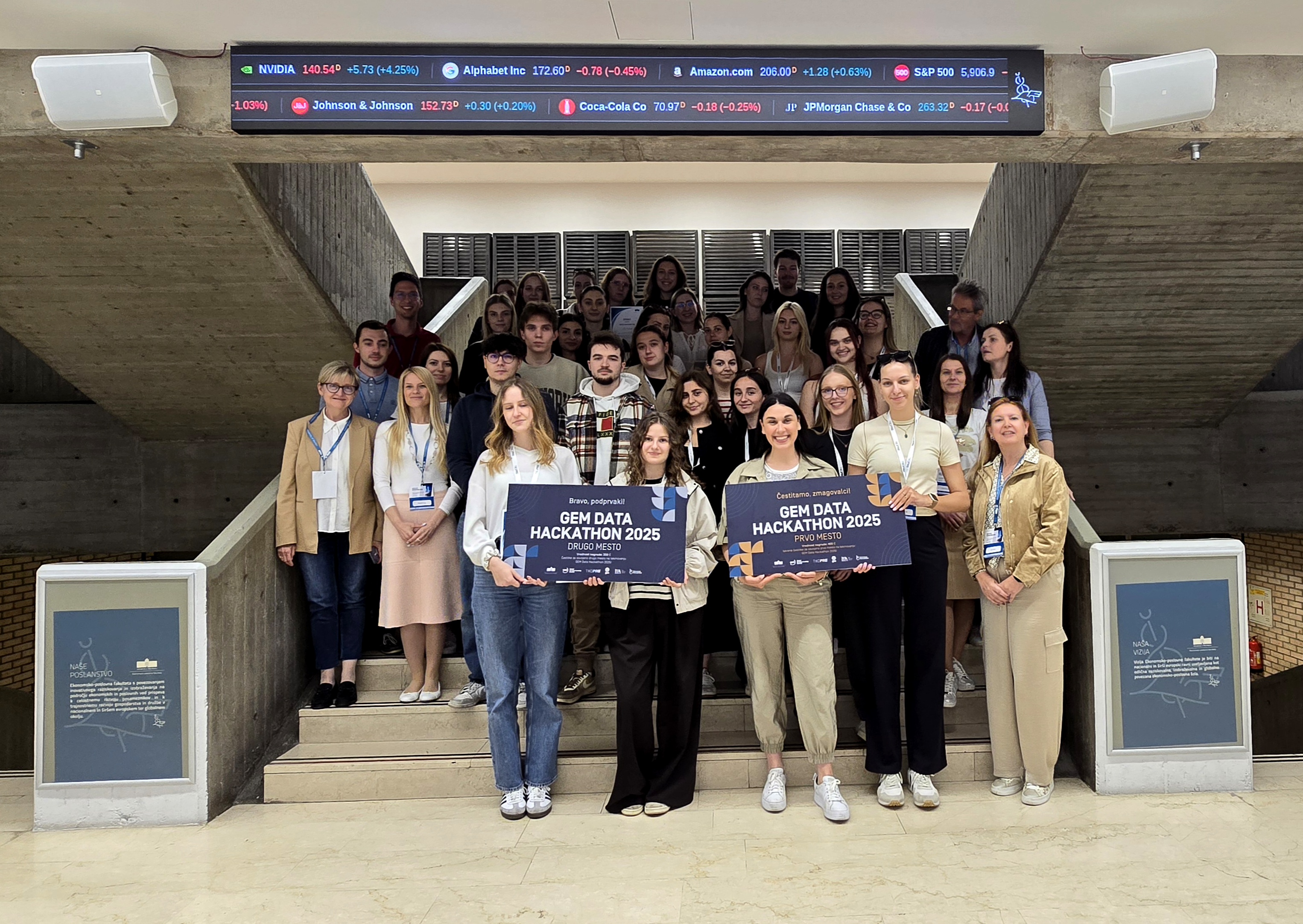
The Faculty of Economics and Business at the University of Maribor, Slovenia, hosted the second GEM Data Hackathon, a full-day data-driven competition that brought together student teams to explore the complex intersection of artificial intelligence (AI) and entrepreneurship. Organised on 29 May 2025 by the GEM Slovenia team in collaboration with the Department of Quantitative Economic Analysis, the hackathon was designed to empower students to turn GEM data into meaningful insights that inform entrepreneurship research and practice.
This year’s theme challenged participants to investigate how entrepreneurs perceive the value of AI in business and what drives or hinders its adoption. Using individual-level GEM APS Slovenia 2024 data, as well as global country-level data from the GEM APS Global dataset, the competition invited students to analyse correlations between AI implementation and a wide range of variables: demographic characteristics, entrepreneurial motivation, business performance, sustainability orientation, and the use of digital technologies.
A hands-on research experience
The event format required teams of two or three students to collaboratively develop a concise research paper and prepare a live presentation of their findings, under tight time constraints. The competition day followed an intensive schedule: after morning briefings, teams had just a few hours to conduct data analysis, draft their reports, and prepare their pitches. The final presentations were delivered to a panel of academic judges with expertise in entrepreneurship and methodology.
Participants were free to choose their research focus from a set of suggested questions, such as:
- How do entrepreneurs’ age, gender, and education affect their openness to AI?
- Do specific entrepreneurial motivations – such as the desire for independence or family legacy – predict more positive attitudes toward AI adoption?
- Are sustainability-oriented businesses more likely to embrace AI tools?
- How does a country's technological and economic development influence AI perception?
Each team was expected to use at least one variable directly related to AI perception or use, and to demonstrate critical thinking, originality, and methodological rigor.
Innovative student insights
Two teams stood out in the final presentations and were recognised with awards for both analytical depth and practical relevance.
The first-place team explored how a blend of human-capital, innovation and industrial-structure factors drives regional economic performance in Slovenia. Their layered multiple-regression design explained more than a third of the variance and passed every classical diagnostic test, translating rigorous statistics into clear levers for balanced regional growth and targeted development funding.
The second-place team examined the environmental footprint of artificial-intelligence adoption across countries, uncovering a modest yet significant correlation between AI intensity and key sustainability indicators. Their evidence offers an early roadmap for greener AI strategies and shows why regulatory thresholds must evolve alongside technological diffusion.
Recognition and support
The organisers gratefully acknowledged the contributions of this year’s sponsors – TikoPro, E-Boniteta, Tovarna podjemov, Gea – Tovarna olja, and Faculty of Economics and Business, University of Maribor – whose support enabled a dynamic and impactful event that brings GEM data closer to future researchers, analysts, and entrepreneurs.
Fostering entrepreneurial and analytical mindsets
The 2025 GEM Data Hackathon continues to grow as an educational platform that merges entrepreneurship, digital transformation, and data literacy. For the students involved, the event provided not only hands-on experience with real-world data, but also an opportunity to develop critical research skills and collaborative thinking in a high-pressure environment. By connecting data-driven analysis with entrepreneurial questions, the hackathon helps cultivate the next generation of researchers who are equipped to address the evolving challenges of innovation, sustainability, and technological change.
Learn more information about GEM activities in Slovenia.